Micke's IT in the Classroom | Timeline of highlights from 1999 - 2021 regarding digitalization
 Micke Kring
·
·
8 min read
Micke Kring
·
·
8 min read
At my advancing age it’s time for a bit of internal tallying about what I’ve been up to for roughly the past two decades. As some of you know, I like to work data-driven. I document, collect data and analyze so I can learn from what I’ve done and preferably avoid making the same mistakes twice.
In the picture (click to enlarge) you can see a timeline of key points in what I’ve done at Årstaskolan and privately — the things I consider a bit more important. They can be small things that meant a lot. A number of sites, apps, services, events and other things that I’ve built and organized in collaboration with teachers and staff. The most important ones are those we built for the students. Many of these no longer exist. 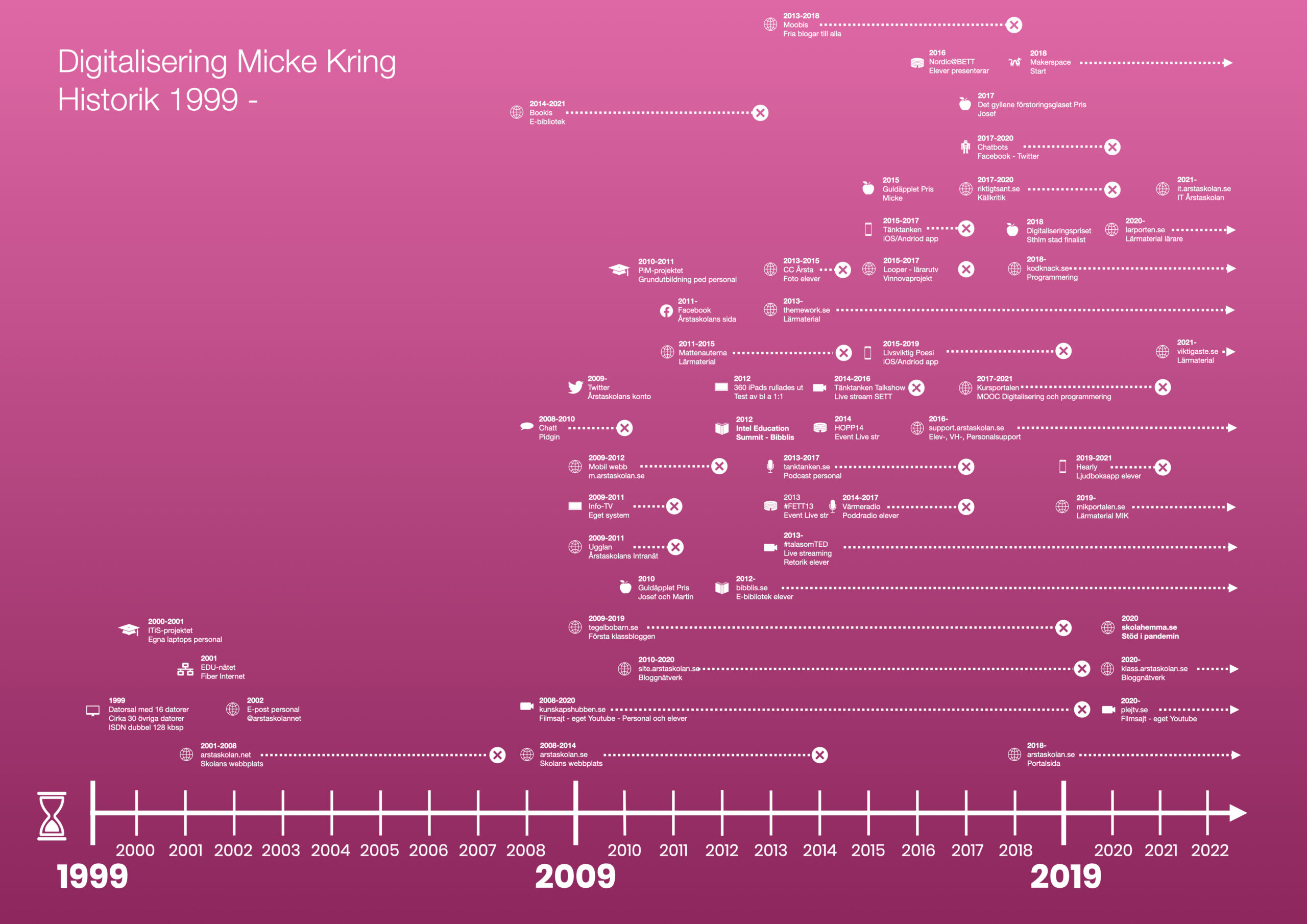 Over the coming weeks I thought I’d take a trip down memory lane. For those of you who work at Årstaskolan you might get a nice flashback. For those who don’t, a glimpse into the school’s digitalization. Of course there is a lot that didn’t fit here, like all the visits around the world. Some things I don’t remember or haven’t yet found documentation for. But starting now I’ll go year by year, beginning in 1999. :) I’ll add to this post, so feel free to come back to it from time to time to read the latest.
(Part 4) 2001 | Micke’s IT at school - the EDU network, email and website
At this time IT was split at the school. Administrative staff like principals had access to email via the city, but not teachers or other non-administrative staff like me. Since I had registered our domain arstaskolan.net (it was much more complicated to get a .se address back then) I offered email to the staff who wanted it. It was voluntary and communication still primarily went via paper in the staff pigeonholes. The school’s “website” also moved into arstaskolan.net.
The big thing this year was that our ISDN connection to the internet was replaced by the EDU network. Suddenly we had 100 megabits straight out to the internet. Fiber. Everything went insanely fast. Network sockets were installed in every room and hall. And suddenly the computers in the computer lab were filled with MP3s and the like, with Limewire and other file-sharing programs running. We still ran Novell as network software and distributed programs, settings and such via the NAL window (the picture shows the NAL window, but a bit later). Novell’s Groupwise was used for email for administrative staff. Of course you could be reached via ICQ in those days. :)
(Part 3) 2000 | The ITiS project and many getting their own work laptop
Published: 16 Nov 2021
2000 — the year we were supposed to be taken down by the Y2K bug — included my 25th birthday and also the dismantling of the student phone at Årstaskolan. Telia removed it due to unprofitability. Mobile phones also started creeping in among the students.
This was also the time when we wrote detailed IT plans and future learning, e-learning, in the form of CD courses could be borrowed from the office. There were courses in Windows 98, Word, Excel, Access and PowerPoint. We were also at the school in the starting gun to get fiber installed. 100 megabits straight out to the internet, in what was called the edu-network. Quite a big difference compared to the ISDN line we had before. I was overjoyed that more and more things broke and needed fixing, because it meant more and more people were using the computers since I had taken over the IT tech duties at the school. It also meant I increased my hours to 50% as IT technician. The big thing for me here was that I built Årstaskolan’s first website, but more on that when it starts to develop. The pages were, of course, built in Frontpage and/or Dreamweaver. Even then we had a mindset about PUL, as it was called back then before it became GDPR. The ITiS project was also a large national initiative for a couple of years, where the government put 1.5 billion into the pot, and teacher teams and similar at schools could apply to test something IT-related in school in the form of a project.
I don’t remember how it happened, but I became a trainer in our district within ITiS. The nice thing about it (which attracted people) was that participants got to (borrow) their own laptop or desktop computer. This meant that many got their first work computer here.
I ran courses for teachers in the district in areas like the internet (and how to search on Altavista), Works (which was more common with us than Word), Pagemaker, Frontpage and Hyperstudio, a tool for digital portfolios, which was hot at the time. It was really fun to teach the courses and it early on helped me build a network in the local area. Next year we’ll dive into Novell, which was the standard server software in Stockholm, with its NAL window and Groupwise for email.
(Part 2) Pre-1999 | Not the first IT wave
Published: 13 Nov 2021

As a little prelude before we continue the story it must be added that I didn’t start when IT was something new in schools. It had already washed over the school world in a few earlier waves.
When I was in middle school in Gävle around the late 80s (at Nynässkolan), we had Compis computers that we ran geography programs on, and in high school (Vasaskolan) in the early 90s you of course wrote your thesis on 386s and 486s in Works in the computer labs. I remember when one of the computers got its first CD-ROM. It was a big event and a bunch of us stood in awe over this revolution. I also made my band’s first demo cover for a cassette on the school’s computers. It was, however, important to run MSAV in DOS to check for viruses. Thanks to a classmate who taught me to always do backups on different disks I didn’t (unlike others) lose my entire thesis, which I wrote about Shakespeare.
But… even before that there were ABC80 computers and Commodore 64s in classrooms in the early 80s. A couple of years ago I was able to pick up a bunch that otherwise would have been thrown away at Medioteket here in Stockholm. As an old C64 owner myself (I still have mine, but it’s broken) I was overjoyed they contacted me. I picked everything up and wheeled it home on my cart. The C64 has been supplemented and is fully functioning with a tape deck in my office. It has a burned-in stamp that it belonged to Stockholm schools 1983, as you can see in the pictures. IT in schools is nothing new, but the difference now is that everyone and everything uses and consists of IT. Earlier initiatives in schools were perhaps a bit too early to take on a broad front. Don’t forget all the pioneers out there who worked at various data centers and the like around the country and saw where this was heading. You are my heroes. You know who you are! Okay, onward…
(Part 1) 1999 | A history lesson
Published: 11 Nov 2021
So far after the fact, my brain may take a little artistic license. Anyhow, here comes 1999. I started my path at Årstaskolan by a fluke as a music teacher at the Youth Center (which was located in Årstaskolan’s premises). I took care of the studio we had there and all the bands that rehearsed. The studio was both digital and analog so we also recorded with reel-to-reel machines.
We had a small computer lab with 6 computers, a Novell server and an ISDN connection. StarCraft ran morning and night and it may have happened that I had to pull the power to get the kids to eat their afternoon snack. At that time my job was mostly a job. It was fun, but music was what I lived for. At the school there was a computer lab (or should I say computer room). 16 computers, a Novell server, dual ISDN connection, but the internet didn’t work and everything was neglected. Cocky as I was (young and dumb) I told the then-principal that I could fix that. I had no idea what the problem was, but found a bunch of papers where, oddly enough, a letter from Telia said they had changed the password to the internet. About the same time internet had stopped working in the computer room. Hmmm. I called the district administration’s technician who had set it all up (and was doubtful that the password was the problem) and asked for the password to the Zyxel modem. I managed to telnet into the modem with the password “pannkaka” and fixed the internet.
Suddenly I was employed as an IT technician at 50%, which became 75% and finally 100%. But that’s a year ahead in time. Pancake! (The password) — the word that started my career. Next year becomes 2000, with the ITiS project where many got their first work laptops. PS. It should also be added to the history that the schools were governed by the district administrations in Stockholm back then and not, as now, the Education Administration.